June 25, 2025

Key Takeaways
- Perform surgical hand antisepsis — scrub fingertips to elbows for the recommended duration, dry with a sterile towel working fingertips outward.
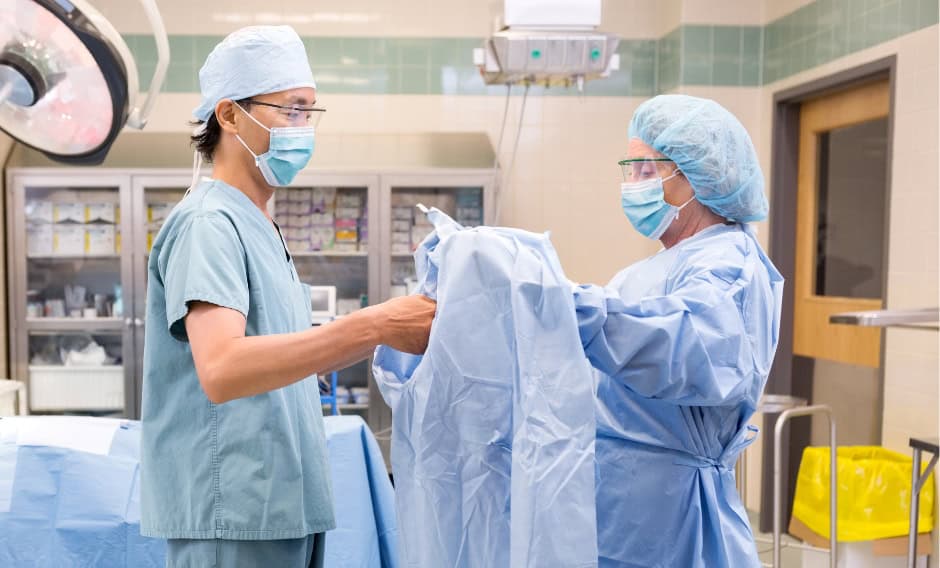
- Open the gown pack using the inner folds; grasp the gown at the inner shoulder area and let it unfold.
- Insert both arms into the sleeves, keeping your hands inside the cuffs.
- Have a circulating nurse or non-sterile assistant fasten the neck and back.
- Don sterile gloves using the closed gloving technique, covering the cuffs completely.
- Adjust for full coverage and secure the waist tie using the sterile tab.
In sterile healthcare environments, precision doesn’t begin with the surgical incision – it starts with proper gowning. One of the most crucial yet frequently overlooked steps in infection prevention is the correct procedure for wearing a surgical gown.
For healthcare professionals, hospital procurement teams, surgical trainers, and medical PPE suppliers, following the standard gowning steps is essential. It not only ensures patient and staff safety, but also supports compliance with healthcare regulations and improves operational efficiency.
This complete guide outlines the step-by-step process of donning a surgical gown, highlights common mistakes to avoid, and offers practical insights for hospitals and medical suppliers to enhance safety protocols through proper training and high-quality disposable protective equipment.
A surgical isolation gown is a sterile, protective garment worn by surgeons, nurses, and other healthcare professionals during surgical and medical procedures. Its primary role is to act as a barrier against contamination, helping maintain a sterile field and preventing healthcare-associated infections (HAIs). These gowns are critical to ensuring the safety of both patients and medical staff.
Fabric is the primary variable in surgical gown performance. Gowns manufactured from virgin polypropylene deliver more predictable barrier behaviour than those containing recycled or reprocessed content, where material consistency cannot be assured from batch to batch. That consistency matters because sterilisation validation is carried out against a defined material specification — if the input material varies, the validation no longer describes what is being supplied.
For procurement teams, three checks are practical: the supplier’s material declaration, batch-level traceability, and whether sterilisation validation is documented for the specific fabric being supplied rather than for the product range in general.
At Dispowear Protection, we use only premium, virgin-grade PP fabric to manufacture surgical gowns that meet strict medical safety standards. Because in surgical environments, there’s no room for compromise on purity or protection.
Also Read: The Future of Protective Wear: Surgical and Isolation Gowns for Pharma
Wearing a surgical gown properly is a critical step in infection control protocols. Whether you’re a healthcare professional or part of a hospital’s procurement team, it’s essential to understand how to wear surgical gown for patient safety. Below is a detailed, compliant process for donning a surgical gown in a sterile environment:
Before gowning, perform thorough surgical hand antisepsis:
This step ensures that no harmful microorganisms are transferred during gowning.
Avoid contact with non-sterile surfaces to maintain gown sterility.
This maintains sterile technique until gloving is complete.
The closed gloving technique minimizes contamination risk during the process.
Removal receives far less attention than donning, yet it is where contamination most often occurs. By the end of a procedure the outer surface of the gown is contaminated, and removal usually happens under time pressure.
The principle is constant: the outer surface must never contact skin, scrubs or the surrounding environment.
Where local policy specifies gown and gloves as a single combined removal motion, follow the facility SOP. The sequence above describes the general principle, not a substitute for your own validated procedure.
Even with proper training, surgical gowning errors can compromise the sterile field and increase the risk of healthcare-associated infections (HAIs). Below are some of the most common gowning mistakes—and simple, effective ways to prevent them:
| Mistake | How to Avoid It |
| Touching non-sterile surfaces while gowning | Designate a clear sterile zone in the gowning area. Conduct regular training to reinforce boundary awareness and sterile technique. |
| Improper gloving technique | Use step-by-step video tutorials and hands-on practice sessions to teach and reinforce the closed-gloving method. |
| Wearing the wrong gown size | Maintain an inventory of multiple gown sizes and implement a quick pre-surgery gown size check for every team member. |
| Skipping pre-gown hand antisepsis | Post visual reminders and instructions near scrub sinks and changing areas to promote hand hygiene compliance. |
Wearing a surgical gown may appear to be a routine task—but when done correctly, it plays a vital role in the broader framework of surgical site infection (SSI) prevention and operating room (OR) safety protocols.
For hospitals, surgical centers, and medical PPE procurement teams, standardizing the steps of wearing a surgical gown is a cost-effective and high-impact measure. It minimizes the risk of contamination, ensures regulatory compliance, and supports efficient OR workflows.
Start with hand antisepsis, open the gown without touching the outer surface, insert arms into sleeves, get assistance to tie the back, use closed gloving, and secure the waist.
It prevents contamination, maintains a sterile field, and reduces the risk of infections during surgery.
It’s a sterile method of putting on gloves while your hands remain inside the gown sleeves to prevent contamination.
Yes, it breaks sterility and increases the risk of healthcare-associated infections (HAIs).
Provide hands-on training, post visual reminders, use video modules, and stock gowns in multiple sizes.
All surgical team members, including surgeons, nurses, assistants, and OR technicians.
Have an assistant release the neck and waist fastenings, then peel the gown away from the body so the contaminated outer surface turns inward. Roll it into a bundle, remove gloves after the gown using a glove-to-glove then skin-to-skin technique, and dispose of it into the designated clinical waste stream.
Dispowear’s disposable isolation gowns are built for correct donning and doffing — fluid-resistant, clean-stitched, and available in bulk for hospitals, surgical centres, and healthcare institutions across India and international markets.
Need surgical gowns for your facility? Request a bulk quote and our team will confirm stock, lead time, and customisation options within 24 hours.

Sandeep Bapna is a commerce graduate. In 1993, he received an MBA with a finance concentration from Mumbai’s Narsee Monjee Institute of Management Studies, following his B.Com. (Hons). Following that, he began working for his father’s company, Mewar Polytex Ltd. He has played a vital role in developing the group’s business from Rs. 3 crores in 1993 to Rs. 650 crores in 2022. He was instrumental in the formation of Anita Plastics, Inc., a distribution company in the United States. He led the team that established Harmony Plastics P. Ltd. in 2005 to produce construction fabrics in collaboration with Alpha ProTech of the United States. He has also served in a leadership role on Rajasthan’s Plastics Export Committee. He serves as the Managing Director of Mewar Polytex Group.
Read More